

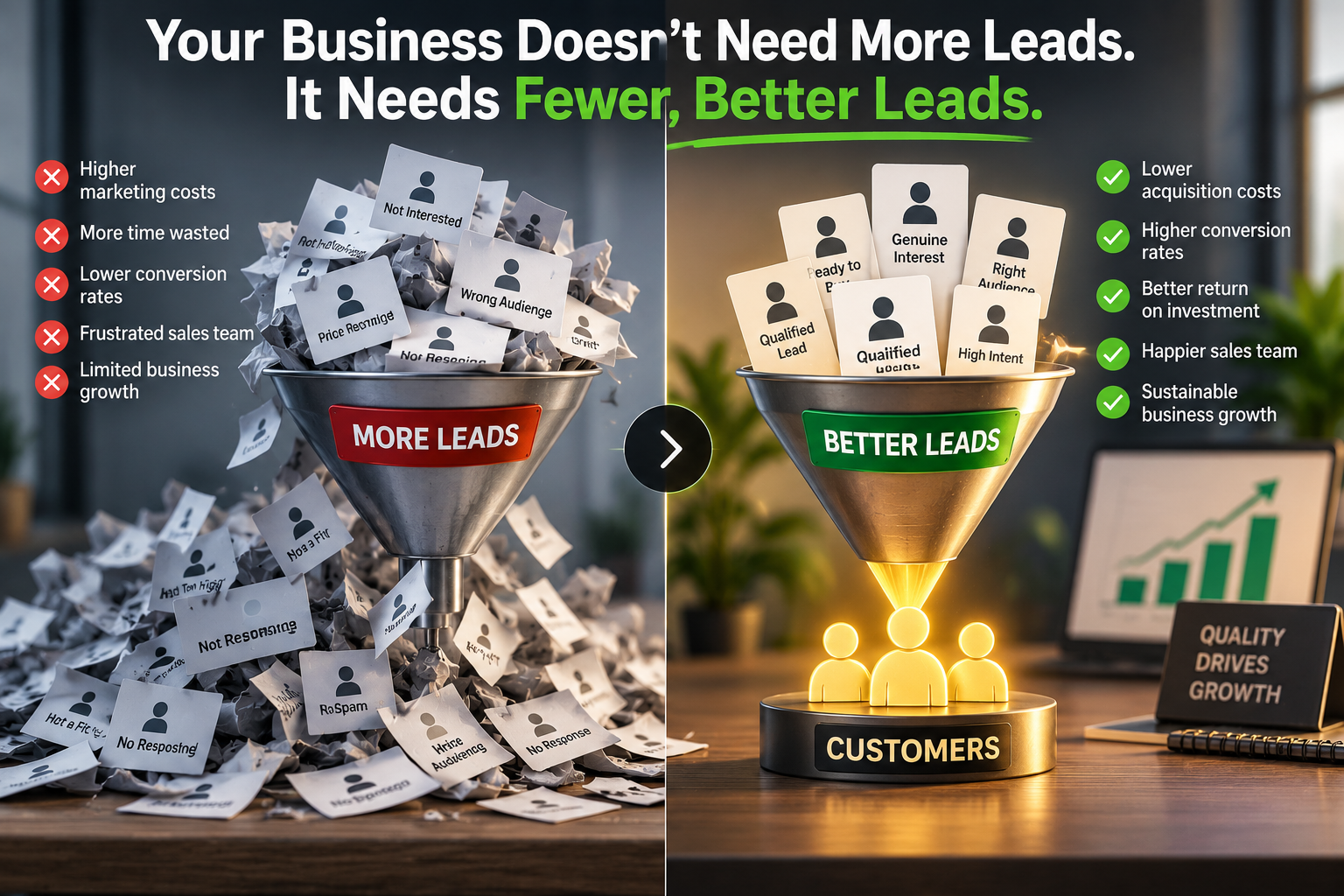
At 10:00 on Monday morning, a business owner opens the advertising dashboard and sees 47 new leads from the weekend campaign. It looks like a success—until the sales team starts calling. One person wants only the cheapest price. Another is outside the service area. Several never answer. A few are still “just checking.” By Tuesday afternoon, the excitement has disappeared, because 47 enquiries have produced almost nothing that the sales team can actually close.
This is the problem with treating lead volume as the definition of marketing success.
A campaign can generate hundreds of enquiries and still perform badly if those enquiries have little buying intent, do not fit the business, cannot afford the offer, or never become conversations.
In many businesses, 100 poor leads can be less valuable than 20 genuinely interested prospects.
The better question is not:
“How many leads did we generate?”
It is:
“How many of those leads had a realistic chance of becoming customers?”
That shift—from lead volume to lead value—can change how a business evaluates advertising, websites, targeting, sales follow-up, and marketing ROI.
Lead Volume vs. Lead Value
Lead volume is easy to report.
You spent ₹50,000 and generated 500 enquiries.
The cost per lead was ₹100.
It sounds efficient.
But suppose only 10 of those 500 enquiries became customers. The business paid ₹5,000 in advertising for every customer acquired.
Now imagine another campaign generated only 100 enquiries at ₹300 each. It cost ₹30,000, but 15 people became customers.
The second campaign generated fewer leads and had a much higher cost per lead.
Yet it produced more customers while spending ₹20,000 less.
That is why cost per lead is not the same thing as customer acquisition cost.
Google itself recommends measuring valuable customer actions rather than stopping at clicks or surface-level activity. Its conversion measurement system is designed to help advertisers identify which keywords, ads, ad groups, and campaigns drive valuable customer activity and understand return on investment.
For a lead-dependent business, this distinction is fundamental.
A lead is an opportunity.
A qualified lead is a more credible opportunity.
A customer is an outcome.
Revenue is the business result.
Why Businesses Get Trapped by the “More Leads” Mindset
The problem starts because lead numbers are highly visible.
A marketing report might show:
1,000 clicks
300 leads
₹150 cost per lead
Those numbers are easy to understand and easy to celebrate.
But they do not tell you whether the people behind those leads actually wanted to buy.
A campaign optimized primarily for inexpensive enquiries can sometimes find people who are willing to submit a form without having a strong intention to purchase.
That can happen when:
- The targeting is too broad
- The offer attracts curiosity rather than buyers
- The form asks for too little information
- The advertisement makes an unrealistic promise
- The campaign reaches people outside the service area
- Price-sensitive users dominate the audience
- The landing page does not explain the offer properly
- There is no qualification process
- Sales follow-up is weak
The result is a strange situation: marketing celebrates more leads while sales complains about worse leads.
Both teams can be looking at the same campaign and reaching completely different conclusions.
A Lead Is Valuable Only If It Can Move Forward
Think about a lead as entering a series of gates.
Lead → Interested → Qualified → Conversation → Opportunity → Customer → Revenue
Every stage removes some prospects.
That is normal.
The problem occurs when a business optimizes only for the first gate.
Imagine a travel company generating 1,000 enquiries for holiday packages. If most people are looking for extremely cheap trips, have unrealistic budgets, are outside the company’s operating region, or never respond after submitting the form, the headline number is misleading.
A smaller campaign producing 150 travellers who have specific destinations, realistic budgets, travel dates, and genuine purchase intent may be far more valuable.
This is the difference between lead generation and qualified lead generation.
The first asks:
“Can we get people to enquire?”
The second asks:
“Can we get the right people to enquire?”
The 10 Metrics That Reveal Lead Quality
A business does not need hundreds of marketing metrics.
It needs a small group of numbers that explain what happens between the first enquiry and the final sale.
1. Lead Volume
How many enquiries are being generated?
This is still useful.
The mistake is treating it as the final measure of success.
2. Lead Intent
Are prospects demonstrating genuine interest in buying?
Someone requesting a quote, asking about availability, providing dates, or booking a consultation generally gives the sales team more information than someone who simply asks, “Price?”
Intent is not always obvious from a form submission, so businesses should define practical signals for their own industry.
3. Lead Fit
Does the prospect actually match the business?
Consider location, service requirements, budget, eligibility, company size, property requirements, course requirements, or other criteria relevant to your offer.
A perfectly interested person who cannot use your service is still not a qualified lead.
4. Lead Quality
Does the enquiry meet your minimum qualification criteria?
A travel company might care about destination, travel dates, number of travellers, and budget.
An education provider might care about course, location, academic level, and admission timeline.
A real-estate company might care about location, property type, budget, and purchase timeline.
Qualification should reflect the economics of the business.
5. Lead-to-Conversation Rate
How many leads actually answer, reply, or speak with your sales team?
This number can reveal problems that the advertising dashboard cannot.
If 100 people submit forms and only 15 ever respond, the business has a serious conversation problem even if the campaign reports 100 conversions.
6. Lead-to-Customer Rate
How many leads become paying customers?
This is one of the clearest indicators of lead quality.
A campaign producing 200 leads with a 1% customer conversion rate deserves very different treatment from one producing 80 leads with a 10% conversion rate.
7. Cost Per Qualified Lead
Instead of calculating:
Advertising Spend ÷ All Leads
calculate:
Advertising Spend ÷ Qualified Leads
This often produces a very different picture.
A ₹150 lead may look excellent until you discover that only one in ten meets your qualification criteria.
8. Revenue Per Lead
Revenue per lead helps connect marketing with financial outcomes.
The calculation is straightforward:
Total Revenue Generated ÷ Total Leads
It becomes even more useful when calculated separately by campaign, audience, channel, destination, service, or product.
9. Customer Acquisition Cost
Customer acquisition cost, or CAC, asks a much more important question:
How much did it cost to acquire an actual customer?
If a campaign produces inexpensive leads but expensive customers, the campaign may not be economically attractive.
10. Marketing ROI
Ultimately, businesses need to know whether their marketing investment creates profitable growth.
Google’s conversion measurement guidance specifically connects conversion data with understanding ROI and making better-informed advertising-spend decisions.
This is why revenue should eventually feed back into the marketing system.
Why Cheap Leads Can Become Expensive Leads
A low cost per lead feels like a victory.
Sometimes it is.
Sometimes it is the beginning of a much larger problem.
Consider a lead that costs ₹50.
If that person has no intention of buying, the business has not acquired a ₹50 customer opportunity.
It has acquired a ₹50 sales task.
Someone still has to call.
Someone has to send WhatsApp messages.
Someone has to answer questions.
Someone has to prepare quotations.
Someone has to follow up.
And someone has to discover that the prospect was never going to buy.
The actual cost is therefore larger than the advertising cost.
People Asking Only for Price
Price enquiries are not automatically bad.
A genuine buyer may absolutely want to know the price.
The problem is when price is the only information a campaign attracts.
If the advertising message encourages people to compare the cheapest possible option, the campaign can become dominated by price shoppers.
Low Purchase Intent
Some people enquire because they are curious.
Others are researching for a future purchase.
Some simply want information.
That traffic may still have value, but it should not be confused with immediate sales opportunity.
Poor Targeting
A business selling premium services may generate plenty of enquiries from people who cannot realistically afford the service.
A local clinic may receive enquiries from outside its service area.
A coaching institute may attract students who do not meet the programme requirements.
More targeting precision can sometimes matter more than more advertising budget.
Duplicate Enquiries
A prospect may submit forms through several websites, campaigns, or lead providers.
From the company’s perspective, the database grows.
From the sales team’s perspective, the same person may appear multiple times.
That makes lead volume even less reliable as a performance indicator.
Leads That Never Respond
A form submission creates the appearance of interest.
A conversation provides stronger evidence.
A customer who responds, discusses requirements, answers qualification questions, and agrees to a next step is much closer to revenue than someone who disappears after submitting a form.
Poor Follow-Up
Lead quality is not determined entirely by advertising.
A good prospect can be lost through slow or inconsistent follow-up.
Google’s advertising infrastructure supports tracking website, phone-call, and offline conversions, allowing businesses to connect advertising activity with later customer actions rather than measuring only the initial online interaction.
That distinction matters particularly for businesses where a lead becomes a customer only after a phone call, consultation, site visit, counselling session, or quotation.
The Lead Quality Test
Before deciding whether an advertising campaign is successful, ask these questions.
Who are these leads?
Are they actually the customers the business wants?
Where are they located?
Can the business realistically serve them?
What are they interested in?
Do they want the product or service being advertised, or something completely different?
Why did they enquire?
Was there a genuine buying reason, or were they simply looking for information?
How many responded?
What percentage answered a call, replied on WhatsApp, attended a meeting, or continued the conversation?
How many were qualified?
How many met the business’s minimum criteria?
How many became customers?
This is where marketing starts connecting with sales.
How much revenue did they generate?
A lead that generates ₹50,000 of revenue should not necessarily be evaluated the same way as one that generates ₹500.
Which campaign generated the best customers?
Look beyond the cheapest CPL.
Compare campaign-level customer conversion and revenue.
Would you pay to acquire this type of lead again?
This final question is surprisingly useful.
If the answer is no, why is the campaign still being optimized for more of them?
A Simple Campaign Comparison
Consider this hypothetical example.
These figures are illustrative only and are not industry statistics.
| Metric | Campaign A | Campaign B |
|---|---|---|
| Leads | 200 | 80 |
| Cost per lead | ₹100 | ₹250 |
| Total ad spend | ₹20,000 | ₹20,000 |
| Customers | 2 | 8 |
| Cost per customer | ₹10,000 | ₹2,500 |
| Lead-to-customer rate | 1% | 10% |
Campaign A looks better if you judge performance only by lead volume and CPL.
It produced 200 leads at ₹100 each.
Campaign B looks worse if you care only about CPL.
Its leads cost ₹250 each.
But both campaigns spent the same ₹20,000.
Campaign A acquired two customers.
Campaign B acquired eight.
That means Campaign B acquired each customer for ₹2,500, compared with ₹10,000 for Campaign A.
Campaign B’s cost per lead is 2.5 times higher, but its cost per customer is four times lower.
That is why a business should never make a major marketing decision based on CPL alone.
If the average customer generates meaningful profit, the difference becomes even more important.
What High-Quality Leads Actually Look Like
A high-quality lead is not necessarily someone who is ready to purchase immediately.
It is someone who has a reasonable combination of intent and fit.
For a travel business, that might mean someone who knows the destination, has approximate travel dates, has a realistic budget, and is genuinely planning a trip.
For a real-estate business, it could be someone looking for a specific property type within a realistic budget and location.
For an education provider, it might be a student or parent looking for a specific course and planning to enrol within the relevant admission period.
For a clinic, it could be a person seeking a service the clinic actually provides and who can realistically visit the location.
The exact qualification criteria change by industry.
The principle does not:
A useful lead has a plausible path to becoming a customer.
How Businesses Can Improve Lead Quality
Improving lead quality does not necessarily mean adding more fields to a form.
It starts with improving the entire acquisition system.
Make the Advertisement More Specific
Tell people exactly what you are offering and who it is for.
Specific messaging can discourage irrelevant enquiries before they reach the sales team.
Make the Landing Page Match the Advertisement
If the advertisement promotes a premium service but the landing page looks like a discount offer, the wrong people may continue through the funnel.
Message consistency matters.
Set Clear Expectations
Where appropriate, communicate location, service scope, starting price, eligibility, timeline, or other important conditions.
This can reduce enquiries from people who clearly do not fit.
Add Qualification Questions
Ask only questions that help determine whether the prospect is relevant.
For example:
What service are you interested in?
When do you need it?
What is your approximate budget?
Which location are you looking for?
Good qualification reduces ambiguity without creating unnecessary friction.
Track What Happens After the Lead
This is one of the most important improvements a business can make.
Do not stop tracking at:
Form Submitted
Track:
Form Submitted → Contacted → Qualified → Opportunity → Customer → Revenue
Google Ads supports offline conversion imports, which can help advertisers connect later offline outcomes back to advertising activity.
That creates a much stronger feedback loop.
Lead Generation Should Serve Sales, Not Compete With It
Marketing and sales sometimes operate with different definitions of success.
Marketing says:
“We generated 500 leads.”
Sales says:
“Only 30 were worth calling.”
Both numbers may be accurate.
The problem is that the business has not agreed on what a valuable lead actually means.
A stronger system creates a shared definition.
Marketing should understand which leads sales considers valuable.
Sales should provide feedback about lead quality.
The advertising team should use that information to improve targeting, creative, offers, landing pages, and campaigns.
Over time, the objective shifts from:
to:
Generate more of the leads that sales can successfully convert.
That is a much more useful definition of performance.
The Real Meaning of “Better Leads”
Better does not always mean more expensive.
It means more relevant.
A high-quality lead should have a stronger relationship with the business’s target customer profile and a more credible path toward purchase.
That can come from better:
- Audience targeting
- Search intent
- Advertising messages
- Offers
- Landing pages
- Qualification
- Follow-up
- Conversion tracking
- Sales feedback
The improvement may therefore happen before the lead is generated, immediately after the form is submitted, or much later in the sales process.
Lead quality is a system problem, not simply an advertising problem.
Where Lead ROI Partner Fits
Lead ROI Partner helps businesses move beyond simply generating enquiries by focusing on more relevant prospects, stronger lead quality, and the connection between marketing activity and measurable business outcomes.
The goal is not necessarily to produce the cheapest lead or the largest number of leads.
It is to build a marketing system where better-targeted prospects have a stronger chance of becoming real customers.
That approach matters whether the business is a local service provider, travel company, real-estate business, education provider, clinic, agency, or another lead-dependent company.
Stop Measuring the Wrong Winner
The cheapest lead is not necessarily the best lead.
The campaign with the most enquiries is not necessarily the best campaign.
The advertisement with the highest click-through rate is not necessarily the advertisement that produces the most revenue.
A business can win every marketing metric and still lose the business outcome.
That is why the most useful reporting chain looks something like:
Leads → Qualified Leads → Conversations → Customers → Revenue → Profit
The further your measurement goes down that chain, the more useful your marketing decisions become.
Google’s own conversion framework reflects this principle by encouraging advertisers to identify valuable customer actions and use conversion information to understand ROI and improve campaign decisions.
And this matters even more as marketing becomes increasingly automated.
HubSpot’s 2026 State of Marketing report says 61% of marketers believe marketing is experiencing its biggest disruption in 20 years because of AI, while 80% report using AI for content creation. The broader lesson is that producing more marketing output is becoming easier; maintaining relevance, trust, and quality becomes more important, not less.
More output does not automatically mean more customers.
More leads do not automatically mean more revenue.
More activity does not automatically mean better marketing.
Final Thoughts
If your sales team is overwhelmed with enquiries but struggling to find genuine buyers, the answer may not be another advertising campaign.
It may be better targeting.
It may be clearer positioning.
It may be stronger qualification.
It may be faster follow-up.
It may be a better landing page.
It may be better conversion tracking.
Or it may be a fundamental change in what your marketing team considers a successful lead.
The central idea is simple:
Don’t optimize only for the number of people who raise their hands. Optimize for the number of people who have a realistic reason, ability, and intention to become customers.
A campaign producing 20 high-quality prospects can be more valuable than one producing 200 low-intent enquiries.
So the next time your marketing report proudly shows that lead volume has increased, don’t stop at the number—how many of those leads were actually worth having?